NeurIPS 2026 · Position Paper

The Missing Pieces of Action ChunkingInsights from Human Motor Control

Wenxi Chen1 Yuejiang Liu2 Zijian He1 Shaoshuai Mou1 Yan Gu1

1Purdue University2Stanford University

Today's action-chunking policies capture only part of what temporally extended motor control requires. Human motor control points to three missing pieces: how chunks are corrected, how they are represented, and how they are coordinated.

  1. Piece IArchitectureAn online correction pathway, predictive and feedback-driven, that runs faster than chunk generation.
  2. Piece IIRepresentationEvent-conditioned action syntax instead of fixed-horizon arrays of low-level actions.
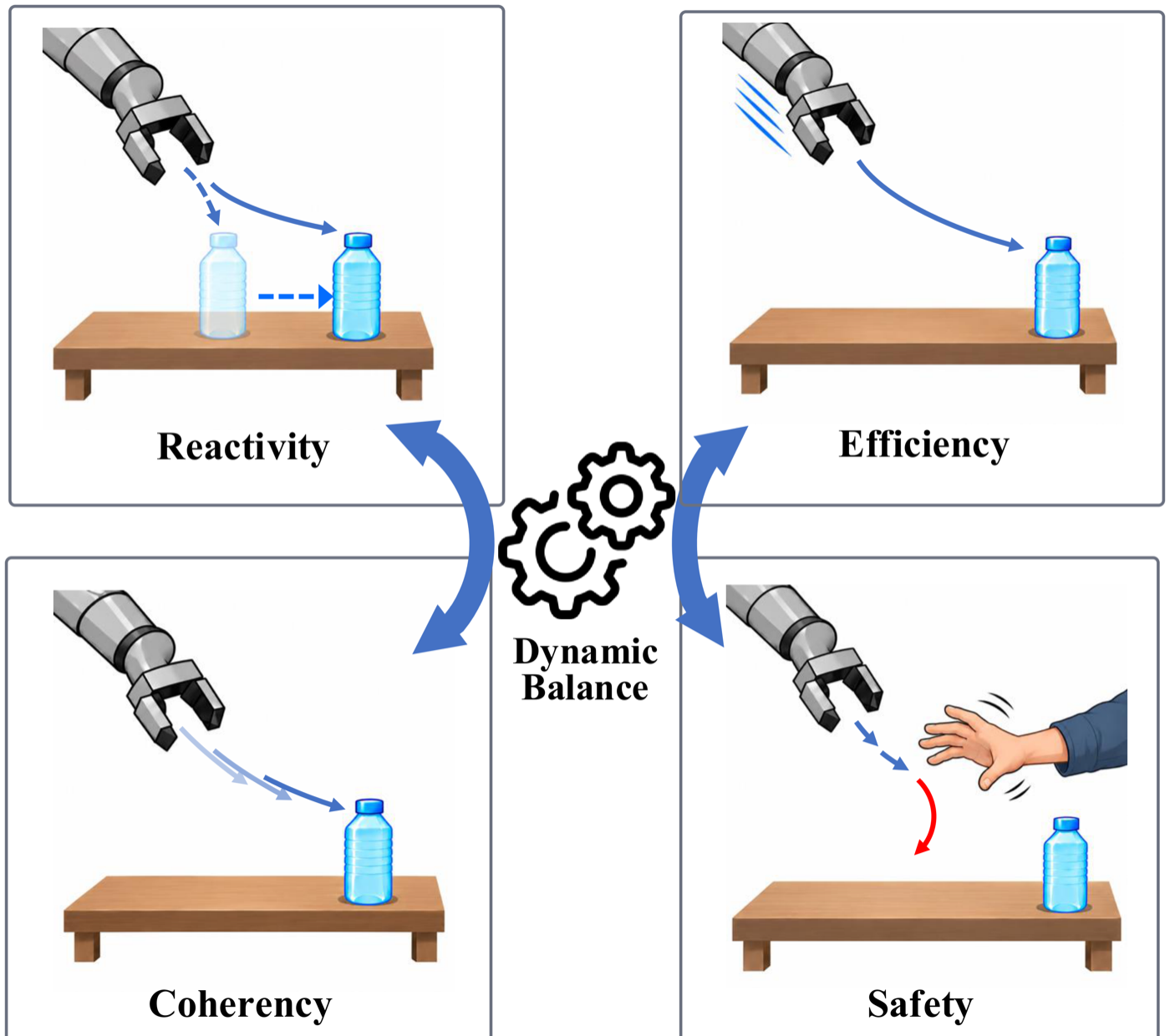
  3. Piece IIIMechanismsCoupled mechanisms that arbitrate between coherence, reactivity, efficiency, and safety.

One policy, six decoding rules

Every panel runs the same chunked policy, trained on static targets, against the same moving target. Only the rule that samples and executes chunks differs. Rules that enforce agreement between consecutive chunks produce smoother motion but fall behind the target; rules that re-plan often stay close but jitter at chunk boundaries.

Run the interactive simulation →
Coherence vs. reactivity. Trails are coloured by the turn angle between consecutive actions (green smooth, orange kink, red sharp jitter); rings mark where a new chunk took over. Coherence is the mean cosine similarity between consecutive actions; reactivity is the mean distance to the target. Once the target moves, no single rule reaches the ideal corner of the trade-off plot. This is a simplified 2-D illustration; the case study below uses Kinetix.

Why revisit action chunking?

Action chunking is widely used in recent robotic policies to improve temporal consistency and mitigate inference latency. Yet, open-loop execution can reduce reactivity and precision, and cross-chunk consistency remains difficult to guarantee. Drawing insights from human motor control, we argue that current action-chunking systems leave three important pieces underdeveloped: the policy architecture surrounding chunk execution, the representation of temporally extended actions, and the mechanisms coordinating chunk generation and execution.

A case study further illustrates the consistency–reactivity trade-off across representative sampling and execution choices. Building on these observations, we outline brain-inspired directions to improve the reactivity and coherence of chunking-based robotic policies in dynamic and complex tasks beyond quasi-static tabletop manipulation. This position paper aims to broaden how the community thinks about action chunking and to motivate redesigns better aligned with future physical intelligence.

Three missing pieces

I

Architecture: online correction during execution

Action chunking borrows from how cortico-basal ganglia circuits compress sequences into executable units, but those circuits mainly select and initiate actions. Fast correction during execution relies on the cerebellum. Most chunking-based policies pass chunks straight to joint-level control, so reactivity depends entirely on how often inference can run. We advocate a dedicated correction layer with two parts: predictive adjustment, where a world model scores or refines candidate chunks and triggers replanning on prediction error, and reactive correction, where a high-rate proprioceptive controller tracks the plan and absorbs disturbances.
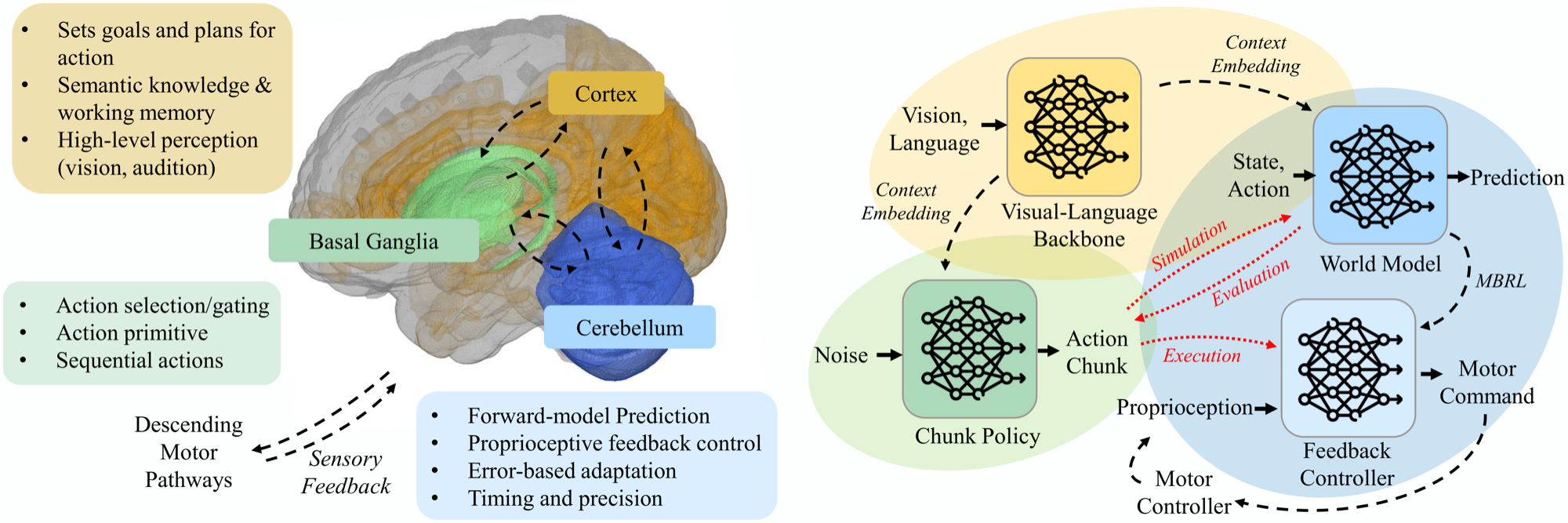
Left: brain regions involved in action generation (cortex, basal ganglia, cerebellum) and their roles. Right: proposed robot architecture with a vision-language backbone, chunk policy, world model, and feedback controller.
Today's chunking-based VLAs roughly parallel cortex and basal ganglia in high-level reasoning, action selection, and chunk-level planning, but lack an explicit cerebellum-like correction pathway. We argue chunked policies should include predictive models that interact with action selection and execution, together with fast proprioception-based feedback (red dashed connections).
II

Representation: from fixed horizons to action syntax

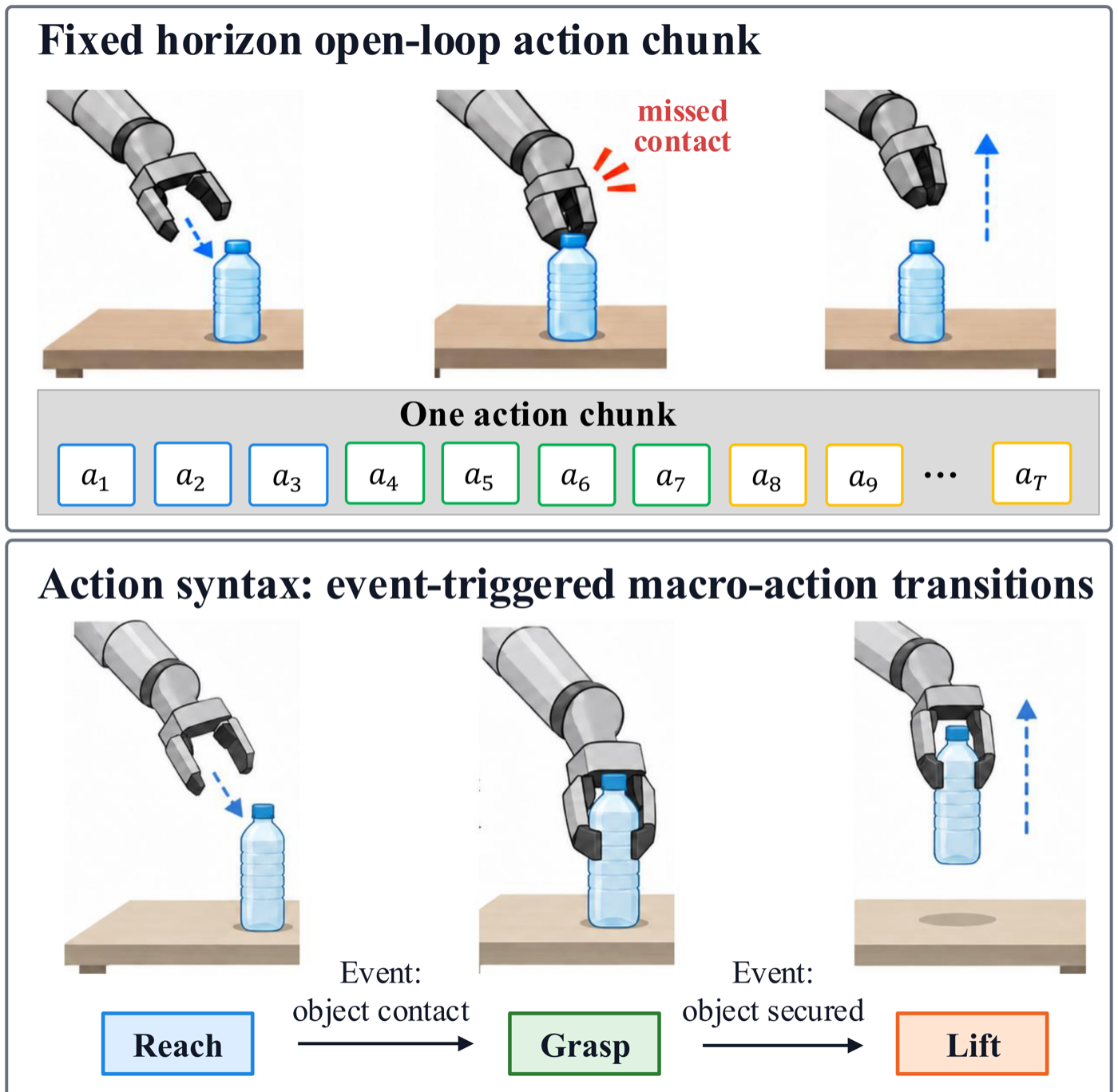
Fixed-horizon chunking ties action sequencing to one time discretization, which makes policies sensitive to variations in phase, speed, and task progress. We argue for syntax-based, event-conditioned sequencing: execute A1 until condition s2, then transition to A2. Transitions are conditioned on state, uncertainty, and sensory events such as tactile contact, visual alignment, or grasp success, so the policy keeps long-horizon coherence while still adapting online.

Top: a fixed-horizon open-loop action chunk misses contact with a bottle. Bottom: action syntax with reach, grasp, and lift triggered by object-contact and object-secured events.
A fixed-horizon chunk executes on schedule even when contact is missed. Action syntax switches between macro-actions when task events occur.
III

Mechanisms: coupled, not isolated

In biological motor control, action sequences come from several computations that cooperate and compete rather than from one fixed rule. Robot chunking faces the same situation. Aligning chunk boundaries improves coherence, while refreshing decisions preserves reactivity, so no single sampling or execution heuristic should be expected to win on every objective. Systems should support switching, blending, and suppressing candidate chunks based on context and uncertainty, so that each mechanism takes control when its assumptions hold.

Four competing objectives (reactivity, efficiency, coherency, safety) arranged around a dynamic balance.
Reactivity, coherence, efficiency, and safety compete with each other. Effective systems should balance them dynamically according to task context.

Coherence mechanisms vs. reactivity under dynamics

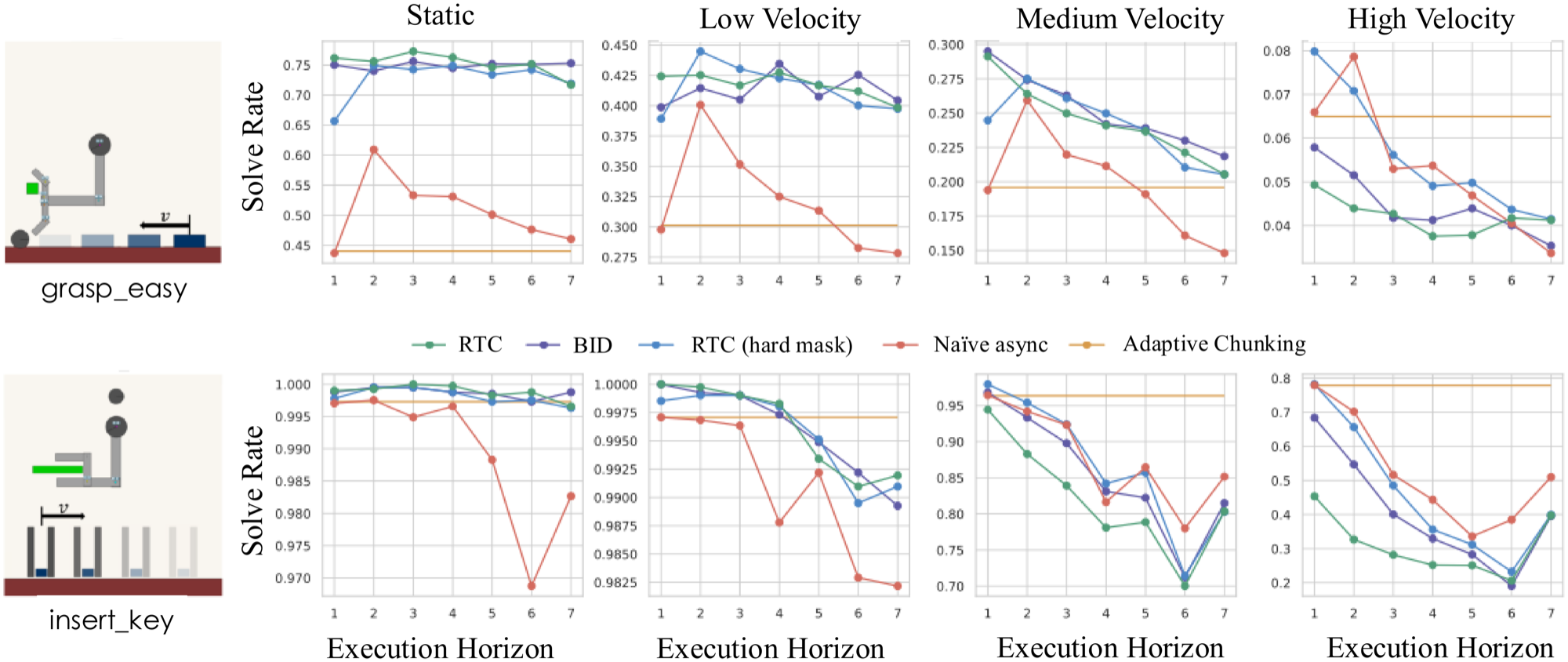
We follow the Kinetix benchmark used in the RTC study. We train expert RL policies and distill an action-chunking policy from their demonstrations. Training uses static targets at random locations; evaluation uses moving targets to stress-test reactivity. We compare coherence-oriented decoding (RTC, RTC with hard masking, BID) and reactivity-oriented execution (Adaptive Chunking) against a naive asynchronous baseline.

Solve rate versus execution horizon on grasp_easy and insert_key at static, low, medium, and high target velocity for RTC, BID, RTC hard mask, naive async, and Adaptive Chunking.
Result 1: coherence-oriented decoding can reduce reactivity. Solve rate across execution horizons on grasp_easy and insert_key, from static to high target velocity. RTC and BID degrade more as target motion increases; RTC with hard masking relaxes some coherence constraints and is correspondingly less brittle.
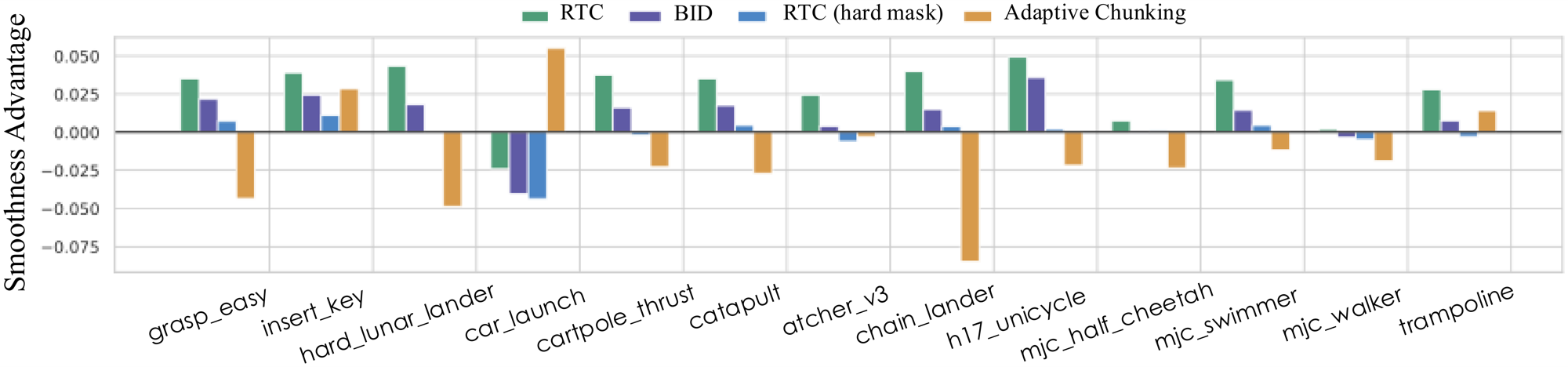
Bar chart of smoothness advantage over the naive baseline across thirteen Kinetix environments.
Result 2: coherence-oriented decoding improves boundary smoothness. Mean cosine similarity between consecutive actions, relative to the naive baseline, averaged over time steps, episodes, and execution horizons 1–7. RTC is smoothest; Adaptive Chunking is the least smooth in most environments.
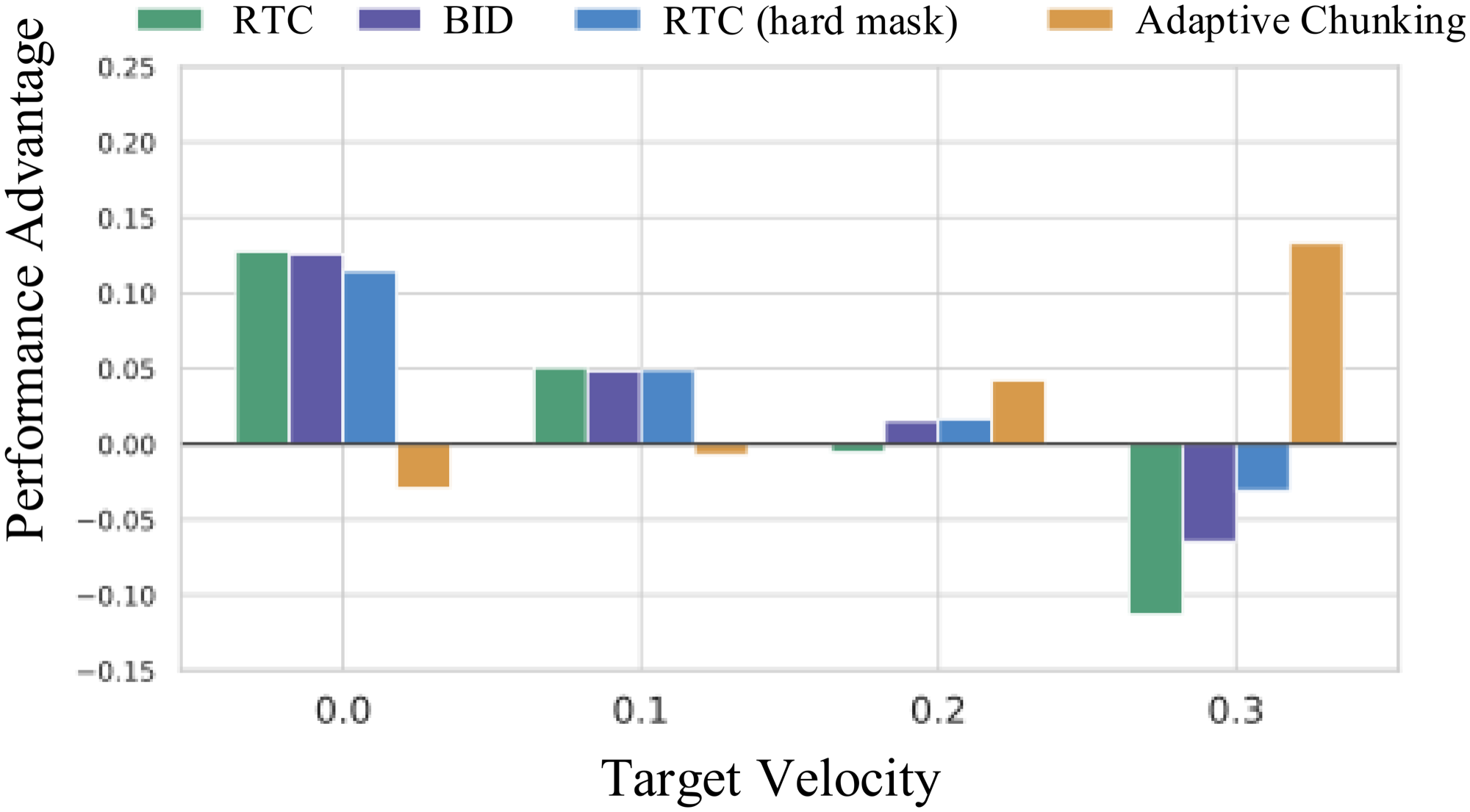
Bar chart of solve-rate advantage over the naive baseline at target velocities 0, 0.1, 0.2, and 0.3.
Solve-rate advantage over the naive baseline as target velocity grows, averaged over execution horizons and both environments. The ranking flips: coherence methods lead on static targets, Adaptive Chunking leads at high speed.

Takeaway. Heuristics that enforce boundary alignment improve smoothness but can reduce responsiveness under dynamics, while reactive execution keeps responsiveness but weakens cross-chunk alignment. No single chunk sampling or execution heuristic Pareto-dominates. Progress requires structured or learned arbitration across complementary mechanisms.

Open questions for the community

Understand why chunking works

Explanations for chunking's success in behavior cloning are not yet unified: mode consistency, non-Markovian context, implicit temporal ensembling, or longer-range prediction. Does chunking help mainly by learning longer-range predictions rather than by committing to long open-loop execution? We call for controlled studies to settle this.

Benchmarks beyond static tabletops

Benchmarks such as LIBERO, CALVIN, and SIMPLER mostly evaluate policies in relatively static scenes. We encourage more dynamic, multi-objective benchmarks that make the coherence–reactivity trade-off explicit under realistic deployment constraints.

BibTeX

@inproceedings{
chen2026the,
title={The Missing Pieces of Action Chunking: Insights from Human Motor Control},
author={Wenxi Chen and Yuejiang Liu and Zijian He and Shaoshuai Mou and Yan Gu},
booktitle={The Fortieth Annual Conference on Neural Information Processing Systems Position Paper Track},
year={2026},
url={https://openreview.net/forum?id=5qqjBkZMmL}
}